Quick answer: Smart toilet remote controls and side panels should provide clear access to frequently used functions, respond consistently, match the approved product version, and remain easy to understand for users, installers, and service teams. A handheld remote offers flexible operation and more space for function keys, while a side panel provides a fixed backup control point on the product. For distributors, wholesalers, bathroom brands, and project buyers, both control methods should be evaluated for usability, installation, customization, testing, version management, and spare-parts availability.
The control interface is one of the most visible parts of a smart toilet. Even when washing, heating, drying, and flushing systems perform correctly, a confusing remote-control layout can create customer complaints, incorrect operation, and additional training requirements.
Business buyers should therefore evaluate the remote control and side panel as part of the complete product configuration rather than treating them as simple accessories.
1. What Does a Smart Toilet Remote Control Operate?
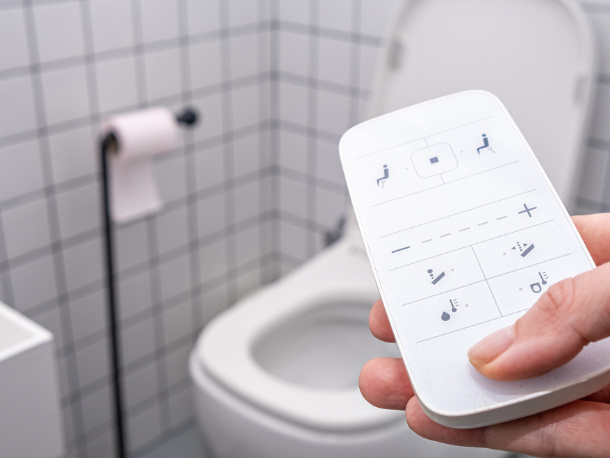
Conclusion: The remote control normally provides access to the main washing, comfort, and automatic functions offered by the selected model.
Depending on the configuration, the remote may control rear wash, feminine wash, water pressure, water temperature, nozzle position, heated seat, warm-air drying, flushing, lid operation, lighting, and other available settings.
Common remote-control functions may include:
- Rear wash and feminine wash
- Water-pressure adjustment
- Water-temperature adjustment
- Nozzle-position adjustment
- Heated-seat adjustment
- Warm-air drying
- Flushing and lid operation
- User or automatic settings, where available
The final function list should match the physical product, specification sheet, manual, carton information, and inspection record.
2. What Is the Purpose of a Side Control Panel?
Conclusion: A side panel gives users direct access to essential functions when the handheld remote is unavailable or inconvenient to use.
A side panel may include only frequently used functions, such as washing, stopping, flushing, or basic adjustment. Its purpose is not always to duplicate every remote-control key.
For project buyers, a simple side panel can support hotels, apartments, and managed properties where remotes may be misplaced. For distributors, it provides a practical demonstration and backup-control point.
3. Which Functions Should Be Prioritized?
Conclusion: Frequently used and safety-related controls should be easier to find than secondary comfort settings.
The stop button, washing functions, flushing, and major adjustments should be visually clear. Less frequently used settings can be grouped separately to avoid an overcrowded layout.
A remote with many buttons is not automatically easier to use. Buyers should consider whether the symbols, text, button size, and function order can be understood by the intended customer group.
4. How Should Buyers Evaluate Usability?
Conclusion: Usability should be tested through real operation rather than judged only from product photographs.
Sample evaluation should include:
- Button visibility and spacing
- Clarity of symbols and wording
- Response speed and consistency
- Ease of changing water, seat, and drying settings
- Operation from the intended user position
- Difference between short press and repeated adjustment
- Availability of a clear stop or cancel control
For wholesalers, a control interface that is easy to demonstrate can reduce sales explanations. For bathroom brands, a consistent layout across several models can simplify marketing and after-sales training.
5. How Should Remote Pairing and Version Matching Be Managed?
Conclusion: Every remote control should be matched to the correct smart toilet model and control version.
Products with similar ceramic appearances may use different control boards, remote layouts, functions, or communication settings. A remote that looks similar may not operate every function correctly on another model.
The supplier should provide a model reference, pairing instructions where required, and a clear method for identifying compatible replacement remotes. Buyers should not rely only on the external shape or button color.
6. Where Should the Remote Holder Be Installed?
Conclusion: The holder should be accessible from the seated position without interfering with doors, fittings, cleaning, or maintenance.
Installation planning should consider wall distance, user reach, door movement, nearby accessories, and whether the holder can be fixed securely to the selected wall surface.
For project procurement, the remote-holder position should be shown in the installation plan or approved through a trial room. Poor placement can make a well-designed remote inconvenient to use.
7. What Should Buyers Check About the Side Panel Position?
Conclusion: The side panel should be reachable, visible enough for routine use, and protected from accidental operation.
The panel position may differ according to product shape and internal structure. Buyers should test access for different users and confirm that buttons are not easily pressed during cleaning, installation, or normal movement around the product.
For compact bathrooms, the relationship between the side panel, wall, water valve, and surrounding clearance should be checked before bulk approval.
8. How Do Control Interfaces Affect Market Positioning?
Conclusion: Remote and side-panel design should support the intended price level and sales channel.
An entry or project model may use a simpler layout focused on washing, stopping, flushing, and basic comfort adjustment. A main-selling model may add clearer temperature and pressure controls. A premium model may include additional automatic functions, displays, or user settings.
For distributors, clear differences between product levels make quotations and showroom explanations easier. Adding minor buttons without a clear customer benefit may increase complexity without improving commercial value.
9. What Customization Is Possible?
Conclusion: Selected remote-control and panel details may be customized, but changes must remain compatible with the product’s control system.
Private label buyers may request brand marks, model names, language, symbols, button descriptions, color arrangements, holder design, or manual content. The available scope depends on the existing product structure, order quantity, tooling, testing, and supplier confirmation.
Artwork changes should not imply functions that the product does not contain. The remote, manual, product label, quotation, and website description must remain consistent.
10. What Should Be Tested During Sample Approval?
Conclusion: Every key and control path should be tested against the approved function list.
- All remote-control buttons
- All side-panel buttons
- Washing, heating, drying, and flushing response
- Adjustment levels and indicator feedback
- Stop and emergency interruption
- Remote pairing or replacement procedure
- Holder position and installation accessories
- Manual descriptions and symbols
Buyers should also test whether the product can still perform essential operations through the side panel when the remote is unavailable.
11. How Should Remote Controls Be Packed?
Conclusion: The remote, holder, fixing parts, and instructions should be secured and included in the accessory inspection checklist.
The remote should not move freely inside the carton or contact the ceramic body. Batteries, where included and applicable, should be packed and documented according to the selected shipping arrangement and applicable requirements.
For project orders, a missing remote or holder can delay installation and room handover. The accessory quantity should therefore be checked before shipment.
12. How Do Remote Controls Affect After-Sales Support?
Conclusion: Remotes and side panels require model-specific identification, troubleshooting information, and replacement planning.
Common service questions may involve no response, limited response, pairing, damaged buttons, incorrect version, unclear symbols, or missing holders. The supplier should help determine whether the issue comes from the remote, power supply, product settings, control system, or incorrect model matching.
Distributors should consider keeping suitable replacement remotes for active models. The spare-parts record should identify the exact compatible version.
13. How Should Buyers Evaluate the Supplier?
Conclusion: A suitable smart toilet supplier should explain control logic, version compatibility, customization limits, and replacement procedures clearly.
- Final remote and side-panel function lists
- Clear control symbols and manual instructions
- Model and version identification
- Pairing or replacement guidance
- Sample testing records
- Customization artwork control
- Accessory and packaging checks
- Compatible spare-parts support
Smart Toilet Control Interface Selection Checklist
- Core functions are easy to locate
- Symbols and wording match the target market
- Remote and product versions are compatible
- Side-panel backup functions are practical
- Remote-holder position has been reviewed
- Every control has been tested on the sample
- Packaging includes all control accessories
- Replacement remotes can be identified
How AF-KangMu Supports Overseas Buyers
AF-KangMu works with overseas distributors, wholesalers, bathroom brands, project buyers, and private label partners sourcing smart toilets and related smart bathroom products. Cooperation discussions can cover remote-control layouts, side-panel functions, model matching, function configurations, installation positions, manuals, branded artwork, packaging, and replacement-part planning.
Buyers can provide the destination market, selected model, preferred functions, language, estimated quantity, and customization requirements so the control interface can be reviewed before sample approval and bulk procurement.
Conclusion
Smart toilet remote controls and side panels connect product functions with the user. A suitable control interface should be clear, stable, correctly matched to the product, easy to install, and supported by accurate documents and replacement parts.
For wholesale distribution, project procurement, customization, or private label cooperation, contact AF-KangMu to discuss your control layout, functions, language, quantities, and market requirements.
FAQ
Does the side panel include every remote-control function?
Not always. It often focuses on essential operations such as washing, stopping, flushing, or basic adjustment.
Can one remote control be used with several smart toilet models?
Only when compatibility has been confirmed. Similar appearance does not guarantee matching functions or control settings.
Can the remote-control design be customized?
Selected branding, language, symbols, and layout details may be customizable, subject to product structure, quantity, testing, and supplier confirmation.
What should buyers test during sample approval?
Test every button, function response, adjustment level, stop control, side-panel backup operation, holder position, and manual description.
Should replacement remotes be prepared for wholesale orders?
It is useful to plan compatible replacement remotes for active models according to the order quantity and local service requirements.